
 1.
Use of the existing alignment
The method uses the existing underground opening to install a new pipe inside the old one, reducing the need for excavation.
Trenchless Technologies
A replacement or rehabilitation technique in which a new pipe is inserted into an existing pipeline.
← Back to technologies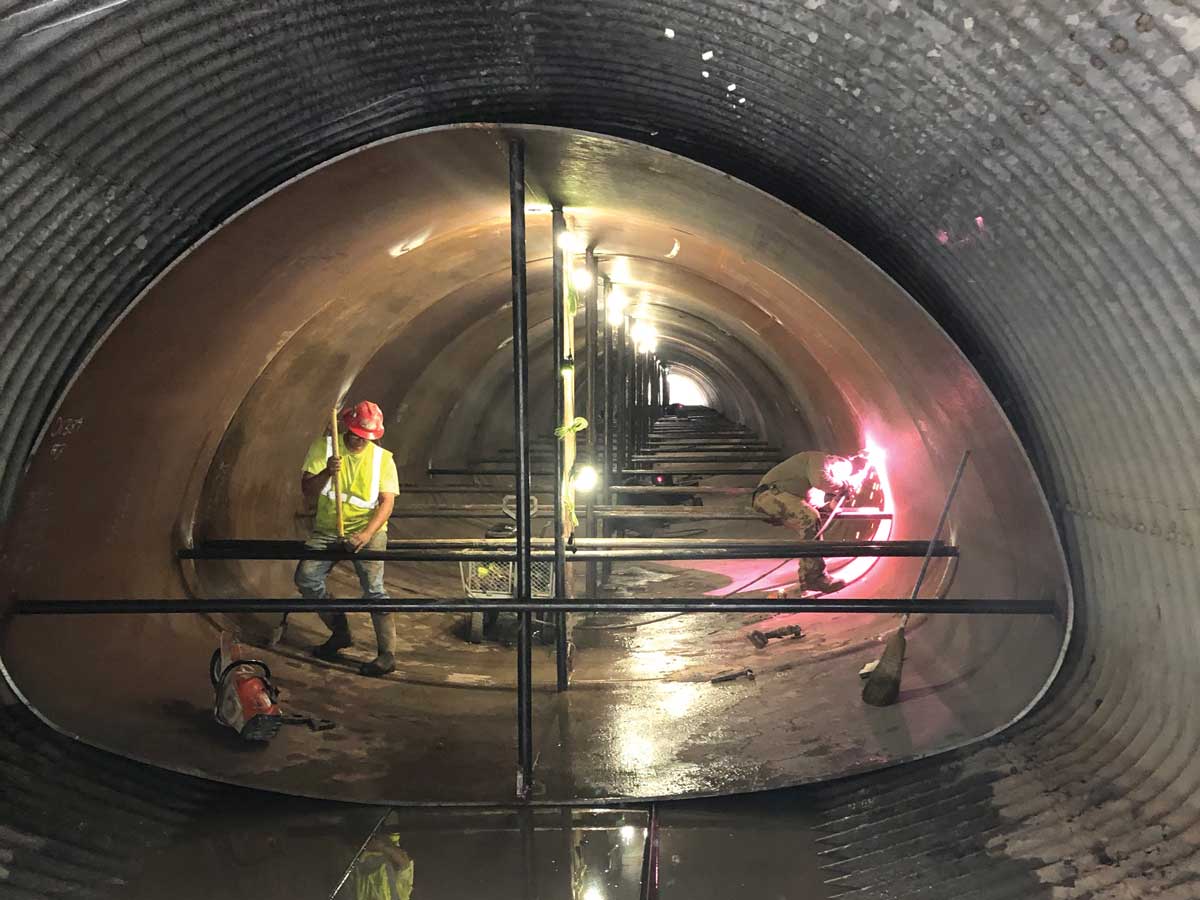
Possibly the simplest rehabilitation technique for pipelines too small for man entry, sliplining consists of pulling or pushing a new pipe into the existing line.
1.
The method uses the existing underground opening to install a new pipe inside the old one, reducing the need for excavation.
 2.
Polymer pipes, especially polyethylene, have increased the popularity of the technique because of their flexibility, strength and ease of jointing.
 3.
Loss of cross-sectional area and the available diameter of the existing line are important factors when assessing the method.
Sliplining consists of pulling or pushing a new pipe into an existing pipeline. The concept of using the existing underground opening to install a new line is long established; records show ceramic pipes being winched into water and sewer lines many decades ago.
Because of its simplicity, the method is especially associated with pipelines that are too small for man entry but still allow a new pipe to be inserted.
The availability of polymer pipes, particularly fusion-jointed polyethylene pipe, greatly increased the popularity of sliplining.
Short-section polymer pipes can be inserted using fusion welding or sleeve-free mechanical joints.
These pipes are also widely used with in-situ replacement methods such as pipe bursting.
Although almost any material could theoretically be used for the new line, high-density polyethylene (HDPE) is the most common choice in practice.
HDPE is well established in potable water and gas applications, is abrasion resistant and is flexible enough to negotiate relatively tight bends during installation.
HDPE can be butt-fusion welded into long continuous lengths before being pulled into the existing pipeline.
After the new pipe is inserted, grouting of the annular space may be required so that the existing structure provides additional restraint and stiffness.
In practice, annular grouting is often one of the most difficult parts of the work.
Loss of cross-sectional area can be significant, particularly where the inserted pipe diameter is governed by commercially available extruded pipe sizes.
Where the diameter must be reduced substantially to pass deformation or displaced joints in the existing line, pure sliplining becomes less attractive than using a slightly smaller replacement pipe.
Despite these limitations, sliplining can still be the most appropriate option in certain situations.
Trenchless Technologies
Browse the technologies presented by ABRATT and discover other solutions for underground networks.