
 1.
Small-diameter pipes
The technique is used in small-diameter pressure pipes where internal man access is not possible.
Trenchless Technologies
A sprayed internal lining for small-diameter pipelines, particularly pressure networks.
← Back to technologies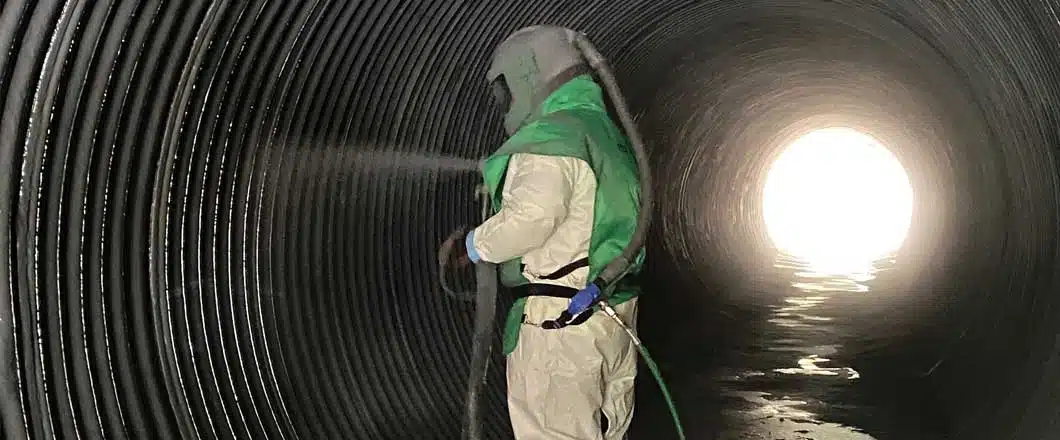
Spray lining is an internal coating system for small-diameter pressure pipes, especially where man entry is not possible.
1.
The technique is used in small-diameter pressure pipes where internal man access is not possible.
 2.
The lining helps inhibit future deterioration, seal small leaks and protect the pipe against corrosion.
 3.
Materials such as cement mortar or epoxy resin can be applied by a robotic spray machine pulled through the pipe at a controlled speed.
Spray lining systems are intended for small-diameter pressure pipes where man entry is not possible.
In water distribution rehabilitation, a common objective is to remove deposits and corrosion and then apply a lining that inhibits future deterioration and seals minor leakage.
The most commonly used materials are cement mortar and epoxy resin.
They are applied by a robotic spraying machine pulled through the pipeline at a predetermined constant speed.
A spray head applies the lining to the inside surface of the pipe, forming an internal protective layer.
Spray lining methods have also been developed for small-diameter sewers without man access, although no process has achieved the same level of commercial prominence.
This may partly reflect different sewer rehabilitation requirements, where the objective is often to increase resistance to external loading and prevent corrosion.
Another challenge is the need to ensure that inflow into the pipeline is completely stopped during lining application and curing.
A practical spray lining system should also minimize the service-reconnection issues inherent in other rehabilitation techniques.
Spray lining is rarely used in gas distribution mains, although in some countries it is extensively used for domestic gas service connections.
Worldwide, its most common application is in potable-water distribution networks.
Trenchless Technologies
Browse the technologies presented by ABRATT and discover other solutions for underground networks.