
 1.
Trajectory control
The bore path may be straight or gently curved and can be adjusted during drilling to avoid obstacles.
Trenchless Technologies
A guided drilling technique for installing networks, pipelines and cables with trajectory control during execution.
← Back to technologies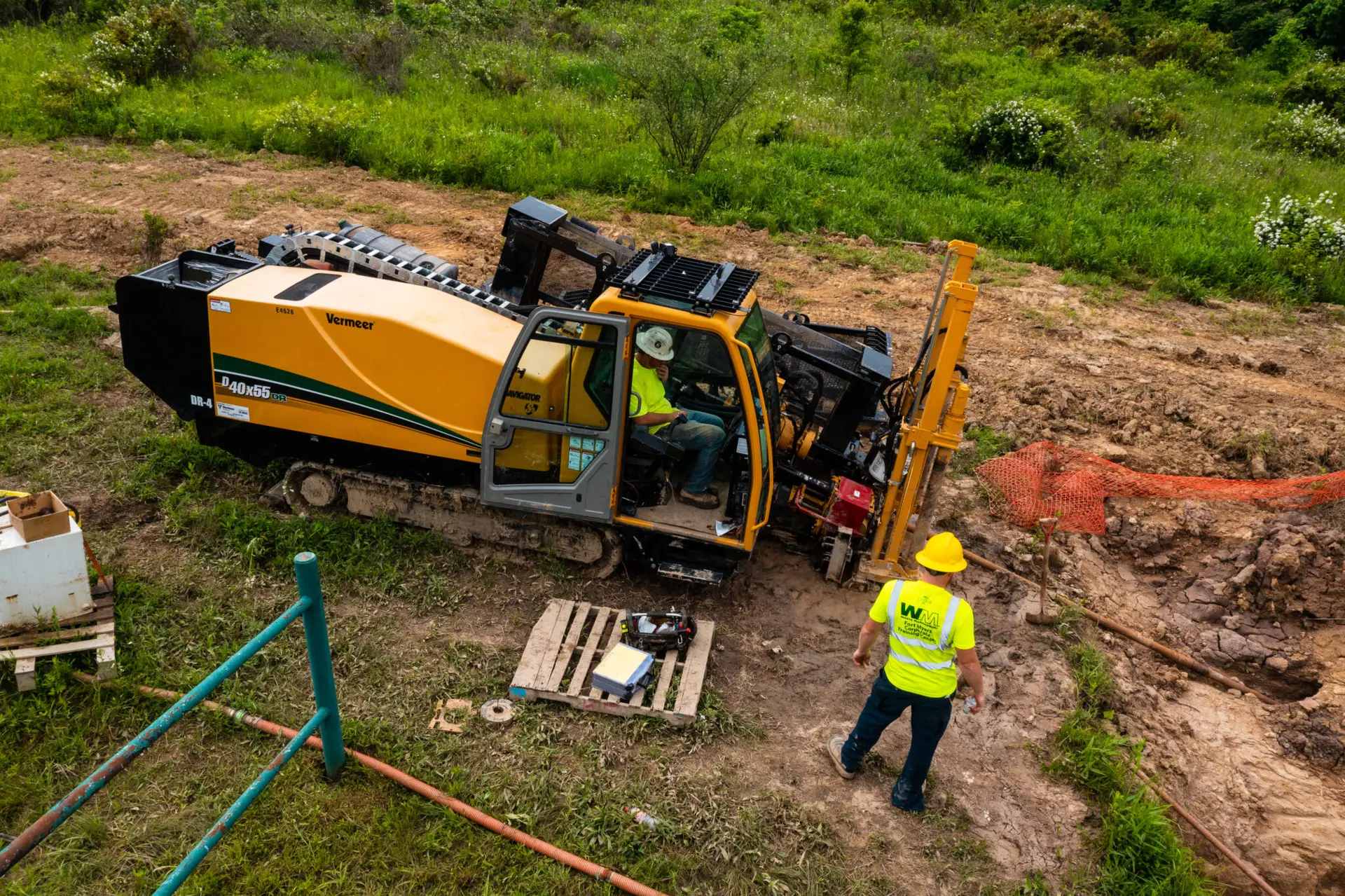
Guided boring and directional drilling techniques are used for trenchless installation of new networks, pipelines and cables, allowing the bore path to be adjusted during execution to avoid obstacles and complete crossings.
1.
The bore path may be straight or gently curved and can be adjusted during drilling to avoid obstacles.
 2.
The method can pass beneath roads, rivers, railways and other obstacles and is used for networks, pipelines and cables.
 3.
Installation normally takes place in two stages: a pilot bore followed by reaming to accommodate the final product pipe.
Guided boring and directional drilling techniques, commonly known as HDD, are used for trenchless installation of new networks, pipelines and cables.
The bore path may be straight or gently curved, and the direction can be adjusted during the work to avoid obstacles or pass beneath roads, rivers and railways.
Drilling may be carried out between pre-excavated entry and exit pits or launched from the surface with the drill entering the ground at a shallow angle.
In terms of capability, guided boring and directional drilling generally fall between impact moling and microtunnelling.
For the purposes of these guidelines, the terms “guided boring” and “directional drilling” are used interchangeably.
Directional drilling is often used to describe the heavier end of the market, such as long crossings beneath major rivers, canals and highways.
However, equipment capabilities overlap considerably, so drawing a rigid dividing line between the two is neither necessary nor particularly useful.
Installation of the final pipe or duct is normally a two-stage operation.
First, a pilot bore is drilled along the planned route. The bore is then enlarged in the reverse direction to accommodate the final product pipe.
During the second stage, the product pipe is attached to the reamer through a swivel connection and pulled into the enlarged bore as the drill string is withdrawn.
In difficult ground conditions or where substantial enlargement is required, one or more intermediate reaming passes may be used so that the bore diameter increases progressively.
Until relatively recently, directional drilling was used mainly for pressure pipelines and cable ducts where precise gradients are not critical.
Gravity pipelines, by contrast, require tight vertical alignment tolerances to satisfy hydraulic design criteria.
Some newer drilling machines and guidance systems can now achieve excellent accuracy under suitable ground conditions.
Directional drilling is therefore expected to become increasingly common for gravity network construction.
Equipment capacity has increased in recent years, while the advantages of trenchless methods for new network construction have become more widely recognized.
Some utilities now actively discourage open-cut excavation, particularly on public roads where a viable trenchless alternative is available.
In addition to environmental benefits, the relative cost of directional drilling has fallen to levels comparable with open-cut construction for many applications.
Such comparisons often do not even include the social costs associated with traffic diversion and delays.
Trenchless Technologies
Browse the technologies presented by ABRATT and discover other solutions for underground networks.