
 1.
Replacement on the same alignment
The existing pipe is fractured while the replacement pipe is pulled or pushed into place behind the bursting tool.
Trenchless Technologies
In-situ pipe replacement in which the existing pipeline is fractured while a new pipe is installed along the same alignment.
← Back to technologies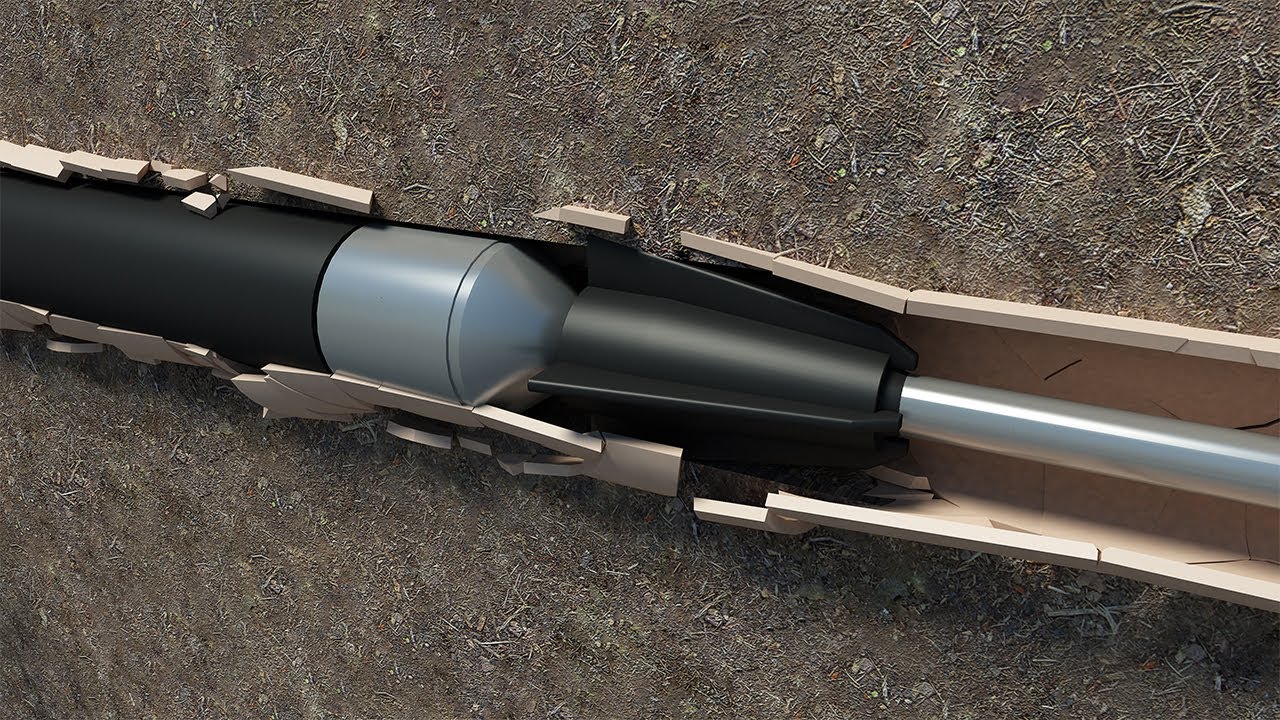
Pipebursting can replace a network with inadequate capacity or a structural condition that prevents rehabilitation, without extensive excavation, using an in-situ bursting replacement system.
1.
The existing pipe is fractured while the replacement pipe is pulled or pushed into place behind the bursting tool.
 2.
The method may use a percussion tool, hydraulic expander or cutting head to break the existing pipeline.
 3.
The method can provide substantial diameter increases, replacing old or undersized networks with new pipelines.
A network with inadequate capacity or a structural condition unsuitable for rehabilitation can often be replaced without extensive excavation using in-situ or direct replacement by bursting.
The most widely used direct replacement system is pipebursting, in which a percussion tool—often a modified impact hammer—or a hydraulic expander breaks the existing line while the final replacement pipe is pulled or pushed in behind the tool.
In some countries pipebursting is also referred to as pipe fragmentation or pipecracking.
Some systems do not use a hammer and operate solely through pulling force or hydraulic rams acting on a conical bursting head.
Other bursting systems use hydraulically or pneumatically powered cutting heads to break the host pipe while simultaneously installing the final replacement pipe.
Pipebursting technology was developed in the early 1980s, originally to replace old cast-iron gas mains.
After its use expanded in the United Kingdom to replace small-diameter cast-iron or asbestos-cement potable-water mains, the pipebursting market began to grow worldwide.
In addition to gas and water renewal, pipe replacement by bursting has become a major trenchless technology for replacing old or undersized sewer networks.
Significant upsizing has been achieved, including installation of a 600 mm plastic trunk sewer in place of a 375 mm concrete pipe.
Typical sewer replacement operations are often in the 150–175 mm range, but 800 mm and 900 mm lines have also been replaced, and tools for pipes around 1200 mm have been developed.
Another trenchless replacement method is pipe eating or pipe destruction, a variation of microtunnelling in which the old pipeline is broken by a tunnel boring machine (TBM) while the new final pipe is jacked into place.
This approach is particularly suited to large diameters and situations where ground displacement from expansion could damage the surface or adjacent utilities.
A more recent system was developed as an adaptation for large directional-drilling rigs, using a special reamer with a spring-loaded impact mechanism to break down the existing pipe.
Because the existing line is expanded or displaced, service connections and auxiliary networks normally need to be disconnected before bursting and most other in-situ replacement methods.
Although remote disconnection techniques have been developed, the most common approach is a small excavation through which the service or auxiliary line can later be reconnected to the new pipe.
The number and frequency of service connections can be decisive when comparing the economics of trenchless replacement with conventional open-cut replacement.
Trenchless Technologies
Browse the technologies presented by ABRATT and discover other solutions for underground networks.